





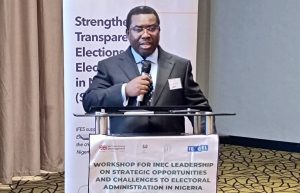
The Independent National Electoral Commission (INEC) has reaffirmed its commitment to strengthening public confidence in Nigeria’s electoral process as it commences early strategic preparations for the 2026 off-cycle elections and the 2027 General Election.
INEC Chairman, Prof. Joash Amupitan, SAN, stated this on Tuesday at a Leadership Workshop organised by the International Foundation for Electoral Systems (IFES) for the Commission’s leadership. The three-day workshop, holding from January 13 to 15, 2026, is taking place at the Radisson Blu Hotel, Ikeja, Lagos State.
Describing the workshop as timely, Prof. Amupitan said INEC is currently navigating a critical phase of leadership transition, marked by changes at the top and the retirement of several directors and senior management staff who have served the nation with distinction. He stressed that institutional continuity must be rooted in clarity of purpose, integrity of leadership and unity of vision, rather than the mere preservation of structures.
According to him, continuity does not mean sameness but the ability to faithfully uphold INEC’s constitutional mandate while adapting to emerging realities with insight and resolve.
Looking ahead to the 2026 off-cycle elections and the 2027 General Election, the INEC Chairman noted that Nigerians expect an electoral management body that is independent in thought and action, transparent in its processes, professional in conduct and credible in its outcomes. He said these expectations have informed the Commission’s ongoing induction and strategic retreat aimed at setting a clear direction for 2027 and beyond.
Prof. Amupitan acknowledged that despite notable reforms recorded between 2015 and 2023, public confidence in the electoral process remains fragile. He warned that democracy cannot thrive without trust, adding that misinformation and disinformation have increasingly undermined confidence in elections.
“In an era where fake news travels faster than the truth, INEC is often compelled to defend its integrity against orchestrated falsehoods even before the first vote is cast,” he said.
He reaffirmed that under his leadership, INEC remains fully committed to delivering free, fair, credible, transparent and inclusive elections in strict compliance with the Constitution, the Electoral Act 2022 and the Commission’s Regulations and Guidelines. Rebuilding public confidence, he added, is a daily operational responsibility guiding every decision of the Commission.
Prof. Amupitan further noted that the leadership workshop, which brought together the Chairman and all National Commissioners, reflects INEC’s belief in collective leadership and shared responsibility in addressing electoral risks and harnessing emerging opportunities.
Also speaking, IFES Regional Director for Africa and Country Director for Nigeria, Mr. Seray Jah, said the workshop marks the early strategic phase of preparations for the 2027 General Election. He stressed that the credibility of elections is largely shaped by decisions taken early in the electoral cycle.
Mr. Jah said IFES has partnered with INEC since 1998 to strengthen Nigeria’s electoral system through support for strategic planning, election operations, technology deployment, institutional reform and inclusion.
According to him, the workshop offers INEC’s leadership an opportunity to reflect on emerging challenges such as complex logistics, responsible use of technology, misinformation and AI-driven risks, internal coordination and sustaining public confidence in a highly polarised environment.
He reaffirmed IFES’ commitment to supporting INEC throughout the 2027 electoral cycle and beyond, while acknowledging the support of the UK Foreign, Commonwealth and Development Office (FCDO) in promoting electoral integrity and democratic governance in Nigeria.
The three-day workshop brought together INEC National Commissioners, senior management staff and international partners to deliberate on strategic opportunities and challenges in electoral administration, with a focus on leadership, institutional resilience and public trust.