





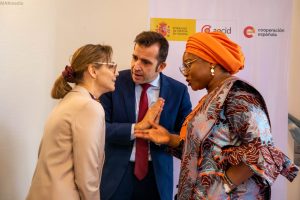
The Federal Government of Nigeria and the Kingdom of Spain have reinforced their commitment to strengthening bilateral cooperation on food security, nutrition, and sustainable livestock development, rallying key international and regional partners to support the initiative.
The renewed partnership was the focus of a high-level meeting convened in Abuja on Tuesday by the Director of the Spanish Agency for International Development Cooperation, Mr. Antón Leis García.
This was contained in a statement on Tuesday, by Oghenekevwe Uchechukwu, Head, Press and Public Relations.
Representing the Minister of Livestock Development, Idi Mukhtar Maiha, the Permanent Secretary, Dr. Chinyere Ijeoma Akujobi, commended Spain for its continued support for sustainable food systems, climate adaptation, and social protection programmes across West Africa.
She identified feed and fodder shortages, rehabilitation of grazing reserves, strengthened biosecurity systems, and gender inclusion in livestock value chains as critical pillars for achieving long-term food security and improved nutrition.
Akujobi stressed that Nigeria is focused on transforming its livestock sector into a climate-resilient and market-driven ecosystem capable of delivering sustainable benefits to farmers, pastoralists, women, and vulnerable groups.
In his remarks, García emphasised the urgency of knowledge sharing and regionally driven solutions in addressing the growing threats posed by climate change, floods, droughts, and market disruptions.
He reaffirmed Spain’s readiness to collaborate closely with Nigeria, the Economic Community of West African States, and other stakeholders to strengthen food systems and ensure inclusive interventions.
Under the ECOWAS Regional Food Security Reserve initiative, Nigeria hosts one of the region’s largest storage facilities, underscoring its strategic role in regional food security coordination.
The meeting drew participation from major development actors, including the Food and Agriculture Organization of the United Nations and the United Nations Children’s Fund, alongside civil society organisations.
UNICEF representatives warned that about 35 million Nigerians across 27 states could face food insecurity during the 2026 lean season, with nearly three million children at risk of severe acute malnutrition.
They noted that malnutrition remains a leading contributor to child mortality, with lasting effects on cognitive development and national productivity.